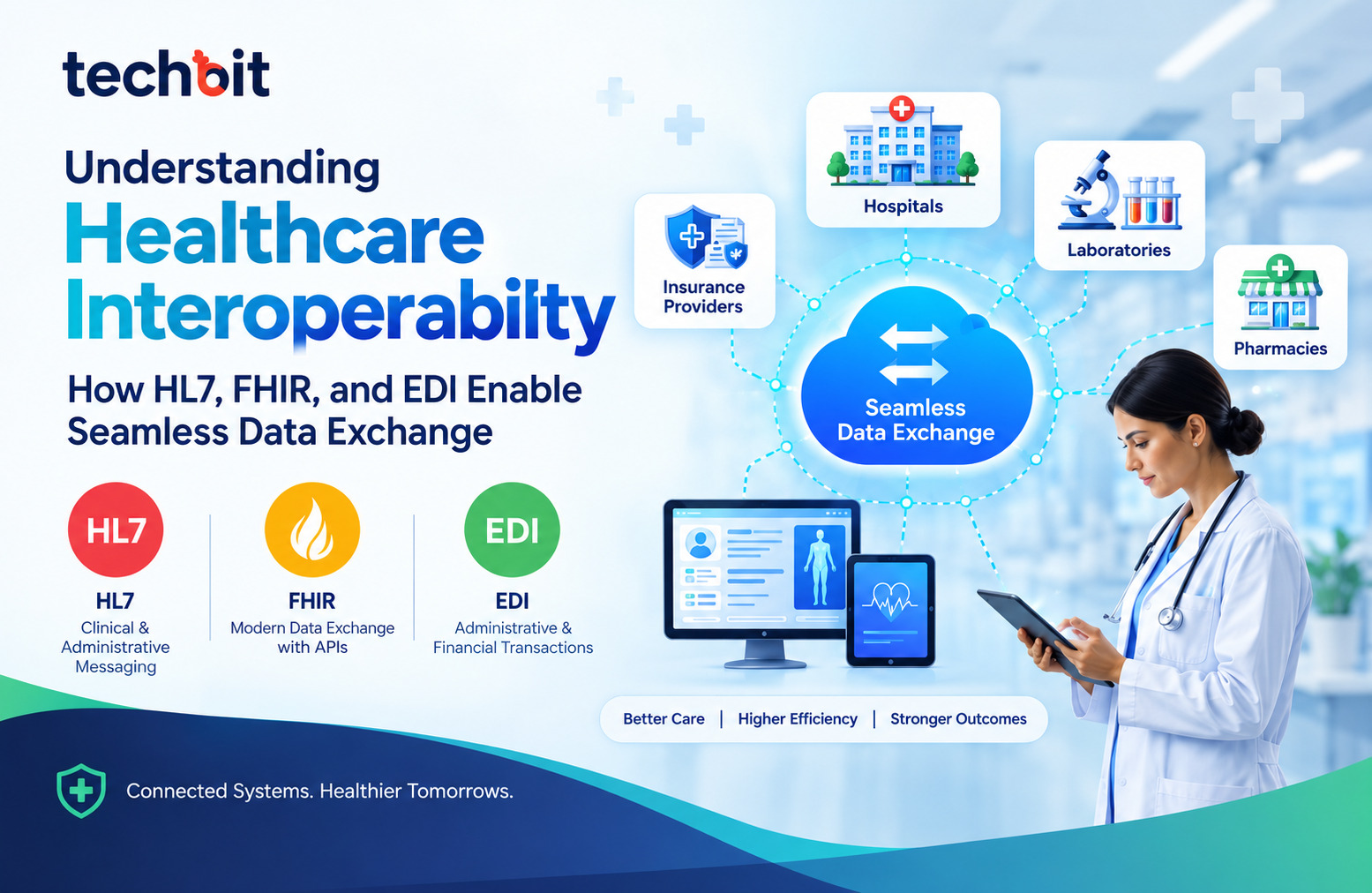
Hospitals, diagnostic laboratories, pharmacies, and insurance providers all use different software systems to run their businesses. The problem is that these systems have to communicate with each other, but they use different data formats or different communication methods. Healthcare interoperability enables this exchange, allowing systems to share and consistently interpret information.
HL7, FHIR, and other standards support clinical data exchange. EDI supports many administrative and financial transactions. Each has a different purpose, but they can work together to bridge critical parts of the health care process. Understanding how these standards work is key to planning reliable healthcare data integration.
What Is Healthcare Interoperability?
Healthcare interoperability means different healthcare systems can share and use information. Staff don’t have to move every record by hand.
Connected systems make information easier to reach, as long as the right permissions are in place.
The major benefits are:
- Less repetitive data entry
- Better access to patient information
- Improved coordination of health providers
- Streamlined administrative procedures
Why Data Integration is Crucial for Healthcare Systems
Healthcare organizations use various platforms for electronic health records, lab results, billing, appointments, and insurance claims. Information is scattered, and there is no link between them.
Effective healthcare data integration moves relevant information between applications.
Clinical Data Exchange
Doctors and nurses need to know patients’ histories, test results, diagnoses, and what medications they are prescribed. The ability to share this type of data facilitates clinical decision-making and collaboration.
Administrative Data Exchange
Administrative personnel deal with registration, insurance information, billing, and claims. The ability to exchange this type of data reduces redundant tasks and increases the ease of management and storage.
How HL7 Supports Healthcare Data Exchange
Health Level Seven (HL7) is a set of standards for exchanging healthcare information between systems. Traditional HL7 messaging standards, including HL7 v2, are widely used in hospitals.
A hospital information system, for instance, may send a lab order to a laboratory system. The results come back electronically.
Common Uses of HL7
HL7 messaging can support the exchange of:
- Patient admission and discharge details
- Laboratory orders and results
- Clinical observations
- Patient identity and demographic information
Format and implementation depend on the systems involved. Integration teams have to map data fields correctly and test messages. Otherwise, information can get lost or misread.
What Makes FHIR Different?
Fast Healthcare Interoperability Resources ( FHIR ) is a healthcare data exchange standard, developed by HL7. It organizes information into resources such as patients, practitioners, medications and observations. It also works with modern web technologies such as APIs.
FHIR Resources and APIs
FHIR lets applications ask for and exchange specific pieces of information. They don’t have to transfer a whole record every time. That can support patient portals, mobile health solutions, and connections between healthcare applications.
FHIR is not a drop-in replacement for all the HL7 interfaces you have today. Depending on their systems and requirements, organizations may use both.
When Is FHIR Useful?
FHIR helps when providers need modern application connections or controlled access to selected clinical information. A successful rollout still needs proper data mapping, access controls, and compatibility testing.
Where EDI Fits in Health Care
Electronic Data Interchange (EDI) allows organizations to exchange structured business documents electronically. It’s widely used in healthcare for transactions between providers, insurers and other administrative partners.
Claims, Eligibility, and Billing
EDI healthcare integration can support transactions such as:
- Insurance eligibility and benefit inquiries
- Healthcare claim submissions
- Claim status requests
- Electronic payment and remittance information
In the United States, certain healthcare administrative transactions use HIPAA-adopted standards based on X12. These serve a different purpose from clinical messaging through HL7, or resource-based exchange through FHIR.
Connecting Clinical, Imaging, and Financial Systems
Healthcare environments often need several standards. Clinical records, insurance transactions, and medical images each hold a different kind of information.
EDI X12, HL7, FHIR, and DICOM integration involves the linking of systems that use these standards for their own purposes:
- HL7: Clinical and administrative messages between healthcare applications.
- FHIR: Standardized exchange of healthcare data through resources and APIs.
- EDI X12: Structured administrative and financial transactions.
- DICOM: Medical imaging and related information.
These standards are not interchangeable. An integration strategy should consider the data to be exchanged, the systems involved and the requirements of each workflow.
Common Challenges in Healthcare Interoperability
Connecting healthcare systems takes more than a technical interface. Organizations also face practical and operational issues.
Inconsistent Data Formats
Various applications may represent the information differently; therefore, data mapping and validation are required to ensure that each instance is properly interpreted by the target system.
Legacy Systems
Older legacy applications may lack the necessary integration tools; hence, the connection methods should be reviewed, and the middleware or API platforms should be selected.
Privacy and Security
Since the software is designed for healthcare applications, the protection of patient data is paramount. Thus, appropriate isolation, permission policies, encryption, auditing, and authentication mechanisms should be established to prevent data breaches.
The Role of Compliance in Data Exchange
Healthcare organizations should consider the privacy and security requirements that are applied when sharing information. Healthcare compliance software can assist with tasks such as access management, audit logging and policy enforcement. You cannot guarantee compliance with software alone.
HIPAA applies to all the covered entities and business associates in certain circumstances in the United States. The GDPR may apply to organizations processing personal data within the scope of the GDPR.
When choosing HIPAA GDPR compliance software, you must consider the laws that apply, the flow of data and the responsibilities of the organization. The two regulations aren’t identical, so don’t treat them that way.
Choosing the Right Integration Approach
Before you connect systems, work out which information needs to move, where it’s going, and who’s authorized to access it.
A practical approach looks like this:
- Review existing software and interfaces.
- Identify clinical, administrative, and financial data requirements.
- Select appropriate standards and integration approaches.
- Test the accuracy of data, access controls, and error handling procedures.
- Continuously monitor the integration and make updates when new systems are adopted.
Organizations considering employing HL7 FHIR integration services should evaluate the compatibility of these solutions with their current systems and future requirements.
Techbit Solutions can provide healthcare software development services related to HL7/FHIR. We recognize that HL7 FHIR implementation is a complex process that requires organizations to consider their existing infrastructure and business processes. Therefore, we offer customized solutions that address our clients’ specific requirements.
FAQs
1. What is ‘Interoperability’ in Healthcare?
It enables communication and the use of information between various medical systems. Once systems are connected and given appropriate access, it becomes easy for health practitioners to access necessary information to provide care and avoid paperwork.
2. What do HL7 and FHIR stand for as far as medical technology is concerned?
HL7 is a set of standards for exchanging medical data, including classical message formats. FHIR is a new standard that organizes data into formats and enables modern web exchange via APIs.
3. Is FHIR replacing HL7?
Not automatically, and not everywhere. Many organizations still maintain their existing HL7 interfaces and adopt FHIR for newer integrations, depending on system compatibility, operational requirements, and available resources.
4. What is the role of EDI in healthcare?
EDI enables the electronic transfer of structured business transactions such as claims, eligibility inquiries, claims status requests, and payment information. Providers and payers share the information in a standard way.
5. How is interoperability helping in patient data protection?
Interoperability enables secure data transfer and exchange by applying proper measures of security. Authentication, permission levels, encryption, and logging are used to protect patient information. Companies should also obey laws regarding confidentiality.