Not long ago, business records meant filing cabinets, printed forms, handwritten notes, and endless spreadsheets. One missing document could send you digging through folders or asking half the office. Digital tools changed how companies store and find information. AI now pushes some of those processes further.
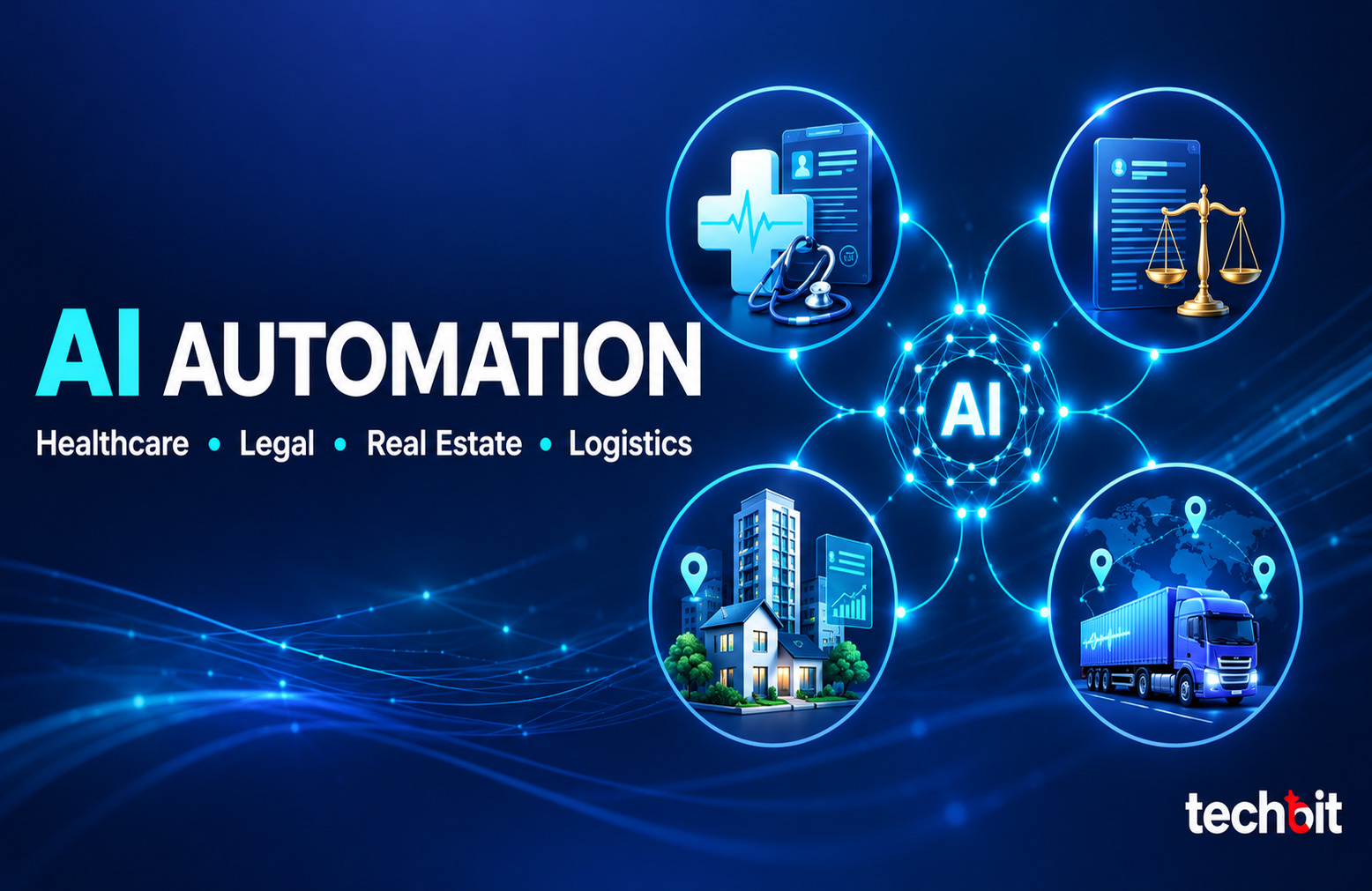
For example, AI automation in healthcare can help with the processing of medical documents and with clinical workflows. Legal teams, real estate businesses and logistics companies can also automate some tasks. Different industries have different needs. The real value is to find practical applications for AI.
How AI Automation Works
AI automation is software with artificial intelligence built in. It takes over tasks that would otherwise be done manually.
Gathering and Handling Information: The process of scanning texts, forms, databases, and other resources. The data is organized, and patterns are identified.
Turning Results Into Actions: Once the information has been processed, the program can begin a workflow, update a record, or provide the information to the appropriate department. If a task needs judgment, a person still reviews it.
How AI Automation Is Transforming Healthcare
Healthcare teams deal with patient records, medical reports, appointments, and admin work. AI can take on some of it. Staff get a cleaner way to handle information.
Medical Records and Document Processing
AI tools can pull information from medical documents and help organize records. That helps with information management. Some medical concerns require an expert examination.
Patient Questions and Appointment Scheduling
Chatbots may be utilized to address common questions and schedule medical visits. In the context of more complex medical concerns, such assistance should be provided by a professional.
Radiology and Healthcare Staffing
The application of chatbots may be extended to radiology and medical staffing. Techbit Solutions presents the AI-powered radiology information system and the AI-based medical staffing agent for healthcare facilities.
These are examples of AI in healthcare operations. They don’t mean AI replaces medical professionals. They don’t mean it can decide every clinical question alone, either.
How AI Automation Is Changing Legal Work
Lawyers deal with contracts, case documents, and supporting records daily. Hunting for one detail in a big file eats time.
Document Review and Data Extraction
Artificial Intelligence can locate relevant information in documents, classify the text, and make the document searchable. This feature becomes handy when there is a lot of documentation in legal cases.
Preparation of Legal Documents
AI-based tools can create drafts using the information that has been provided by users. Legal practitioners will have to verify the content.
We at Techbit Solutions have created an AI-based demand draft system, which uses ChatGPT-4 for text processing and Amazon Textract for OCR processing. The goal of this is to help produce legal demand drafts from unstructured documents.
How AI Automation Is Changing Real Estate
Property businesses handle client inquiries, listings, appointments, and project information. AI automation in real estate keeps those threads organized.
Lead Management and Follow-Ups
Automated workflows can sort new leads, log customer interactions, and remind employees about follow-ups they haven’t done yet.
Property Records and Project Tracking
Software can help teams manage property information, schedules, inventory, and project records. AI may support data analysis too, if the right information is available.
Our real estate CRM case study covers scheduling, inventory management, sales, project management, document management, and reporting. Those are documented CRM capabilities. The case study doesn’t establish that every function uses AI.
How AI Automation Is Improving Logistics
Logistics teams coordinate shipments, delivery schedules, vehicles, and operational data. AI automation in logistics can support some planning and information-processing work.
Planning the Route and Schedules for Deliveries
AI can examine the data and give the best route and schedules, taking into account traffic conditions and the capacity of the vehicles.
Shipment Tracking and Fleet Coordination
Automation can help in managing the details of each shipment, vehicles, and drivers, thus making the operations more efficient and giving the logistics managers the required information faster.
Demand and Operational Analysis
AI can process the historical data and determine patterns that can be used to make predictions. In this way, the logistics managers can combine the results of such analysis with their expertise to plan the operations and make decisions.
Challenges Businesses Should Consider Before Automating
AI automation isn’t just a tool purchase. Understand your workflows first. Then decide where automation belongs.
Data Quality and Privacy
Analysis based on incomplete data can provide inaccurate results. Consider access control, privacy, and sensitivity of the information.
Smooth Integration with Existing Legacy Systems
The new system may need to be integrated with the databases and applications currently used in the company. It is critical to evaluate in what ways these technologies can be incorporated into the new program and whether there are particular requirements.
Human Review and Accountability
There’s a need for human workers to double-check the results, as algorithms are prone to making mistakes. A company should have clarity on who makes the final call, and an employee should be held responsible if AI errors are missed.
The Role of Software Development in AI Automation
Many businesses need software built around their own processes. A general-purpose AI tool often doesn’t fit.
Solutions built around business needs
Businesses can turn to AI software development services to find applications for particular workflow needs. Document processing, information management, and task automation are common examples.
Artificial intelligence software development services can also consist of linking an AI model to existing applications and testing its results.
Building and Maintaining Software Products
Software product development services include designing, building, testing and maintaining software products. Test AI capabilities against what they are supposed to do and how well they do it.
At Techbit Solutions, we deal with AI and machine learning, mobile application development, web application development, and other software development services. Businesses can look into these services to find out how they could match their project needs.
FAQs
1. Which business processes are most appropriate for automation using AI?
The processes that can benefit from the introduction of AI are repetitive tasks, work with huge amounts of data, documents, and monotonous activities. Before starting the automation of business processes, it is necessary to carefully select a task, explore the available data, and understand how relevant it is to intervene in the existing system.
2. Can small businesses benefit from automating processes with AI?
Small businesses can benefit from automation by applying artificial intelligence to customer service, data entry, and document management. It is essential to start by solving a specific problem and try to understand how useful the technology is in practice rather than immediately implementing it on a wide scale.
3. How important is data quality in AI-driven automation?
Insufficient or incorrect data can lead to inaccurate results. Therefore, it is necessary to study and collect the required information, examine it for errors, and periodically update it.
4. How can businesses evaluate the effectiveness of automated processes with AI?
Businesses should track the speed and accuracy of processes, the number of errors, cost, efficiency, and load on employees. By comparing the indicators before and after the introduction of technologies, it is possible to determine whether the implementation was effective and how high the degree of automation was.
5. What factors should businesses consider before scaling up automated processes with AI?
Before scaling up the use of AI in business processes, it is necessary to look at the system’s effectiveness, consider the infrastructure, security, and maintenance requirements, and study the staff’s readiness. A critical factor is also an experiment with other processes to find out their resistance and the potential for automation.